Know what is real.
Technical due diligence for investors, founders and engineering teams. Every claim a technology makes, traced to its code, its tests and its evidence — and a written verdict on what holds.
Can you spot the failure?
What is B’s worst-case response time?
The method, applied to DY Research's own tool
Every engagement does this for every claim that matters — and says plainly where the evidence stops.
One question.
Three people who ask it.
Before the term sheet.
A deck full of technical claims, a closing date, and nobody on the team who can read the code.
You need to know what the technology is — not what it is described as — and what could break the investment.
- You receive
- An independent, written verdict on what holds, with every claim traced to its evidence and the risks ranked.
- Start with
- Due Diligence, or a Snapshot to screen a deal.
Before the investor asks.
Diligence is coming, and the question is whether your code can prove what your deck says.
Where it cannot, you would rather hear it first — while there is still time to close the gap.
- You receive
- A claims-to-evidence matrix of your own system, with every gap named and ranked.
- Start with
- A Snapshot, or a Focused Audit for the one property that matters most.
When the deadline is physical.
A timing failure that survives every fix. A safety case that has to hold up in review. A race nobody can corner.
You need the failure traced to its cause, in writing, by someone who has done it before.
- You receive
- The execution model rebuilt from source, worst-case timing with every iteration shown, and the failure chain traced end to end.
- Start with
- A Focused Audit.
Fixed price. Fixed scope.
A written verdict.
Three engagements, each answering one kind of question. The price is agreed in writing before any work begins.
- Architecture map, as built
- Claims-to-evidence matrix
- Engineering health: tests, CI, dependencies
- The risks that matter, ranked
- Questions to put to the founders
- Everything in Snapshot, and:
- Execution model rebuilt from source
- Worst-case timing with DY-WCET
- The failure chain, evidence kept apart from hypothesis
- Fixes, each with the test that confirms it
- A stated confidence boundary
- Everything in Focused Audit, across the whole system, and:
- Security and software supply chain
- Technical debt and scalability
- Every technical claim in the deck, traced
- Risk register, severity and likelihood
- A memo for the investment committee
The verdict is yours.
The infrastructure is everyone's.
Revenue from every engagement funds AxonOS — an open-source, deterministic systems layer for neurotechnology — and its path to independent foundation governance.
Independent technical intelligence
The investigation, the evidence review and the written verdict you receive — carried out by the principal, start to finish.
Open infrastructure
Continued development of the AxonOS infrastructure layer and its open-source components: the real-time kernel, the signal pipeline, and consent enforced below the application layer. axonos.org ↗
Funding AxonOS never shapes a verdict. If a company under review competes with AxonOS or builds on it, you are told at scoping — before you commit to anything.
Exactly what you are buying.
Side by side, or one engagement at a time.
| Snapshot5 business days | Focused Audit2–3 weeks | Due Diligence3–4 weeks | |
|---|---|---|---|
| Understand | |||
| Architecture map, as built | ✓ | ✓ | ✓ |
| Claims-to-evidence matrix | ✓ | ✓ | ✓ |
| Engineering health | ✓ | ✓ | ✓ |
| Ranked risks and questions for the founders | ✓ | ✓ | ✓ |
| Investigate | |||
| Execution model rebuilt from source | — | ✓ | ✓ |
| Worst-case timing with DY-WCET | — | ✓ | ✓ |
| Failure chain and proposed fixes | — | ✓ | ✓ |
| Stated confidence boundary | — | ✓ | ✓ |
| Decide | |||
| Security and supply chain | — | — | ✓ |
| Technical debt and scalability | — | — | ✓ |
| Open-source licence inventory | — | — | ✓ |
| Every claim in the deck, traced | — | — | ✓ |
| Risk register and committee memo | — | — | ✓ |
| Terms | |||
| Written round of questions | — | ✓ | ✓ |
| Mutual NDA | Standard | Standard | Standard |
| Price | $5,000 | $12,000 | $25,000 |
Snapshot
Five business days from confirmed scopeWhat does this technology actually do, and what does its evidence support?
For
Investors screening a deal. Founders preparing for one.
Included
- An architecture map of the system as built, not as described
- A claims-to-evidence matrix: every public technical claim traced to code, tests or CI, or marked unverified
- Engineering health: tests, CI, dependencies, release discipline
- The risks that matter most, ranked, with the evidence for each
- Questions to put to the founders
You receive
A one-page executive summary, the written report and the evidence matrix.
We need from you
Access to the repository or product, the deck or technical documentation, and the question you most need answered.
Not included
Running the build, measurement on hardware, and changes to the code.
Focused Audit
Two to three weeks from confirmed scopeDoes this one critical property actually hold?
For
CTOs with a system that has to be right. Investors with one specific technical doubt.
Included — everything in Snapshot, and
- One property investigated to the bottom: worst-case timing, determinism, concurrency and races, verification claims, or the security of one component
- The execution model rebuilt from source
- Worst-case response times with DY-WCET, every iteration shown, where timing is the question
- The failure chain traced end to end, evidence kept apart from hypothesis
- Proposed fixes, each naming what would confirm it and what would rule it out
- A stated confidence boundary: what the evidence proves, and where it stops
You receive
The audit report, the artefacts needed to reproduce it, and one written round of questions after delivery.
The standard
An RP2350 timer that stopped for minutes — a complete analysis, published in full.
We need from you
The above, plus the property in question and any logs, traces or measurements you already hold.
Not included
Instrumentation on a bench, changes to your code, and a second property, which is quoted separately.
Due Diligence
Three to four weeks from confirmed scopeIs the technology what the company says it is — and what could break the investment?
For
Investors before a term sheet. Acquirers. Boards.
Included — everything in Focused Audit, across the whole system, and
- Architecture, code quality and technical debt
- Security posture and the software supply chain
- Testing and verification maturity
- Real-time and determinism claims, wherever the product makes them
- Scalability limits and single points of failure
- An open-source licence inventory — technical, not a legal opinion
- Every technical claim in the deck, traced to its evidence
- A risk register, each risk rated for severity and likelihood
You receive
A two-page memo written for an investment committee, the full report, the risk register, the evidence appendix and one written round of questions.
We need from you
Repository access, the deck and the technical materials in the data room, and one technical contact who can answer in writing.
Not included
Legal, financial or commercial diligence, and investment advice. The findings are technical; the decision stays yours.
A verdict a board can act on.
Every engagement ends in writing: the question, the answer in one sentence, the arithmetic written out, and the line where the evidence stops. These are the two documents investors read most, shown on a robotics company.
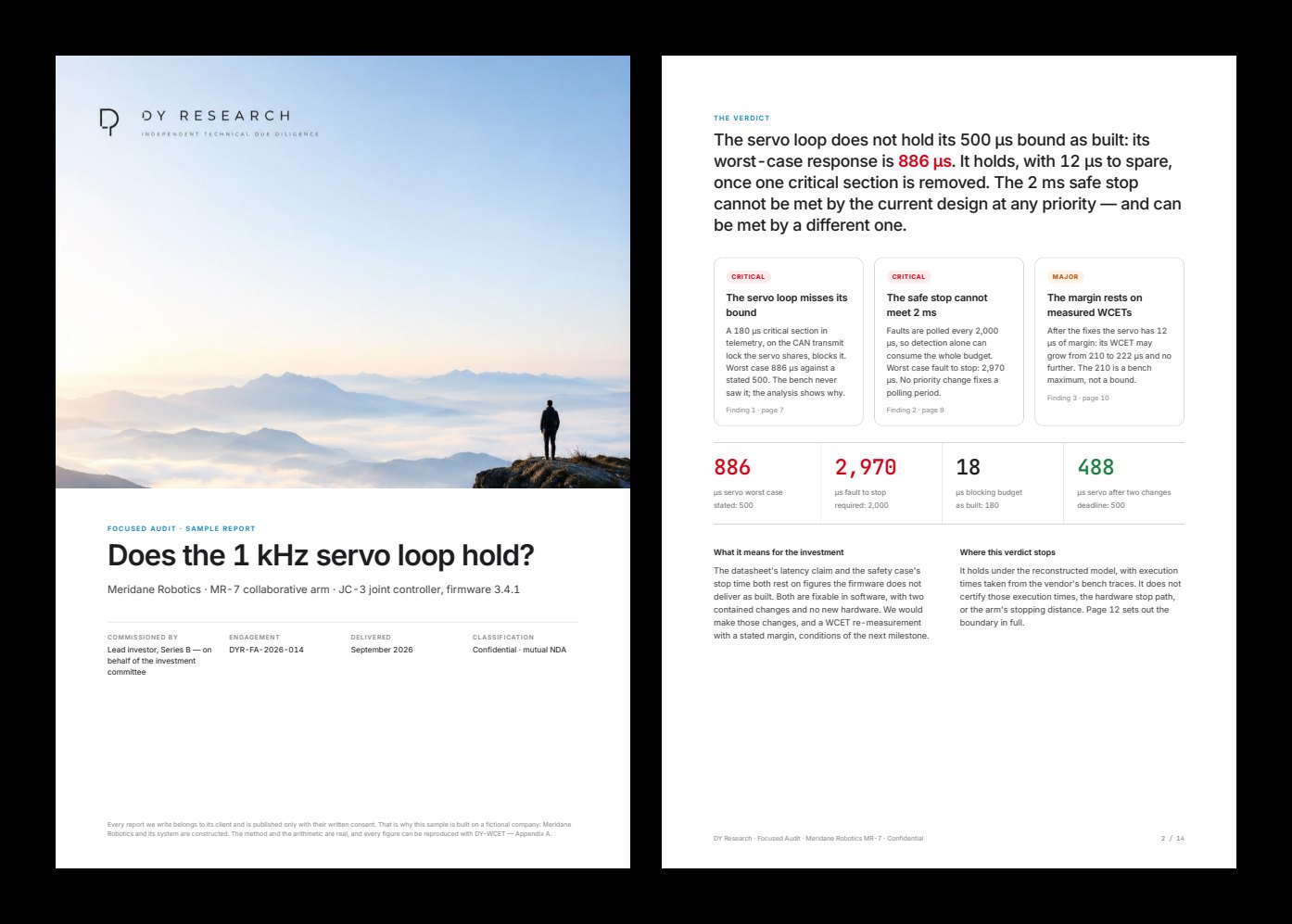 Focused Audit · 14 pages
Does the 1 kHz servo loop hold?
The full report: the claim traced, the system reconstructed, every iteration shown, three findings, the fixes with their own tests, and the boundary.
Read the sample report
Focused Audit · 14 pages
Does the 1 kHz servo loop hold?
The full report: the claim traced, the system reconstructed, every iteration shown, three findings, the fixes with their own tests, and the boundary.
Read the sample report
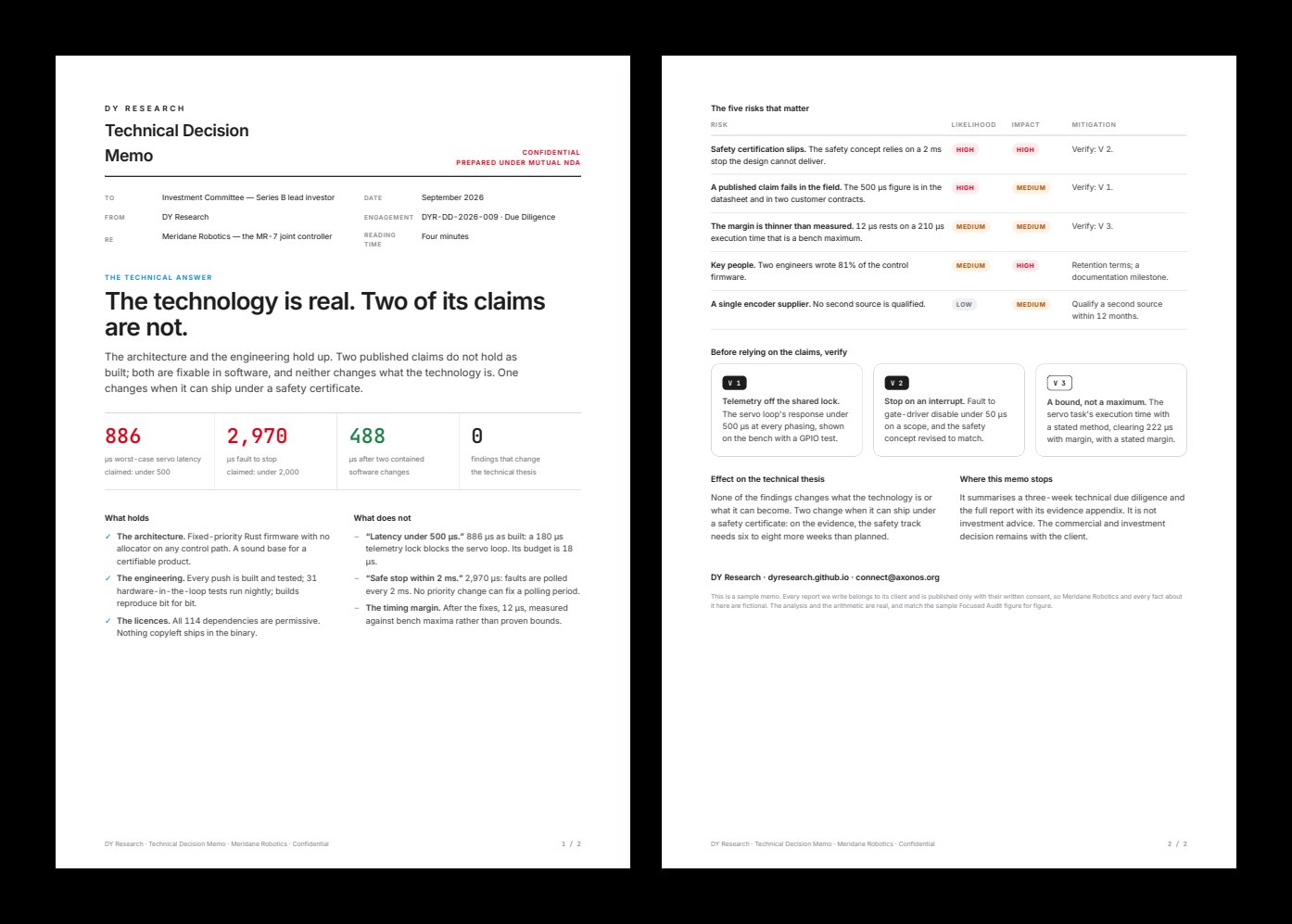 Due Diligence · technical decision memo · 2 pages
The technology is real. Two of its claims are not.
What a committee reads before it decides: what the evidence establishes, what could invalidate the technical thesis, and what to verify before relying on it. The decision stays with the committee.
Read the sample memo
Due Diligence · technical decision memo · 2 pages
The technology is real. Two of its claims are not.
What a committee reads before it decides: what the evidence establishes, what could invalidate the technical thesis, and what to verify before relying on it. The decision stays with the committee.
Read the sample memo
- Produced with the tools every engagement uses. DY-WCET for the analysis, an independent simulation of the schedule to check it, and the reporting pipeline that typeset these. Nothing here was drawn by hand.
- Every figure reproducible. The report shows the code that recomputes it.
- Fact, assumption, hypothesis. Marked on every claim, so you know what rests on what.
What you show us stays yours.
Your code, your numbers and the way your system is built are the competence you are selling. An engagement reads them; it does not take them.
Why is the company in our samples fictional? Because no client’s work is ever shown without their written consent.
- Before
A mutual NDA, before the first file. On every engagement, not only the largest.
- During
Read-only, and only what the question needs. Access ends at delivery.
- After
Nothing kept but the report. Every copy of your material is deleted, and the deletion is confirmed in writing.
- The report
Yours. You decide who reads it: your board, your investors, your engineers.
- Always
Nothing published without your written consent. Not the findings, not your name, not the fact that we worked together. And nothing learned in your engagement is used in another.
Written first.
No call required.
Send the question
What to investigate, what you need to know, and by when.
Scope, fixed
Scope and price come back in writing, with any conflict of interest disclosed.
The investigation
Carried out by the principal, start to finish. Evidence kept apart from hypothesis.
The verdict
Every claim traced to its evidence, and a stated boundary where the evidence stops.
Questions
One written round after delivery, on anything in the report.
Built in public.
Check the work before you buy it.
Three open systems stand behind the practice. Each can be inspected, run and verified without asking anyone.
A living map of open neurotech.
Open brain–computer-interface projects, tracked and scored from public evidence and updated continuously. Each score is published with the evidence it rests on, so any of them can be reproduced.
Timing analysis that refuses rather than rounds.
Worst-case response time for real-time systems, in integer arithmetic. When it cannot justify a bound, it returns a named refusal instead of a number — and it is the tool the Focused Audit uses.
A real-time operating system for brain–computer interfaces.
An open-source kernel in no_std Rust on ARM Cortex-M, with bounded worst-case response times and privacy built below the application layer, where an application cannot bypass it.
One principal. No handoffs.
Every engagement is carried out by Denis Yermakou, start to finish. The person who writes the verdict is the person who read the code.
Author of the Radar, DY-WCET and AxonOS — the work above, all of it open.
What an engagement is not.
Not investment advice
The findings are technical. The decision, and everything commercial around it, stays yours.
Not a certification
No standard's qualification is issued or implied. What you receive is the analysis a certifier would ask to see.
Not a warranty
Evidence and reasoning, set out so they can be checked — by you, or by anyone you ask.
Bring the question.
Leave with the evidence.
Scope and a fixed price come back in writing. Nothing is invoiced until you agree.